

How To Motivate Employees And Inspire Your Team
According to a 2022 Gallup survey, only 1 in 5 employees worldwide say that they are happy at work, with the rest stating that they are disengaged and don’t find work meaningful.
In this post, we will discuss different models for increasing engagement and motivation in your team and share various strategies that you can use to improve employee satisfaction.
Motivation is a key factor in the success of any team. When your employees are engaged and motivated, research has shown that it can result in improved productivity, better job performance, higher retention rates, and increased innovation and creativity.
So, as a manager, what are some of the ways that you can create highly motivated and engaged employees? To help you with this, we’re going to look at three different models of human motivation.
Model No. 1 – Maslow’s Hierarchy of Needs
One of the most famous models of motivation is Maslow’s hierarchy of needs. Maslow’s hierarchy of needs was created in the 1940s, and states that individuals have fundamental needs that they bring to work, starting with physical needs such as food and shelter, which create the foundation of the hierarchy. The next layers of the hierarchy include safety needs, belonging needs, self-esteem needs, and self-actualisation needs.

Maslow hypothesised that once physical needs were met, people’s attention would shift to the other needs in the hierarchy. However, research since then has shown that this progression is not as linear as Maslow expected. The key takeaway here is that while these needs are ALL important, different people prioritise different needs and can have a range of needs that span across the different categories. As a manager, you must try to understand each member of your team, and their individual needs, to be able to address them in the workplace.
Model No. 2 – Herzberg’s two-factor model
The second model of human motivation is Herzberg’s two-factor model, which was originally published in the Harvard Business Review in 1968. This model identifies two types of factors that affect job satisfaction and job dissatisfaction: hygiene factors and motivators.
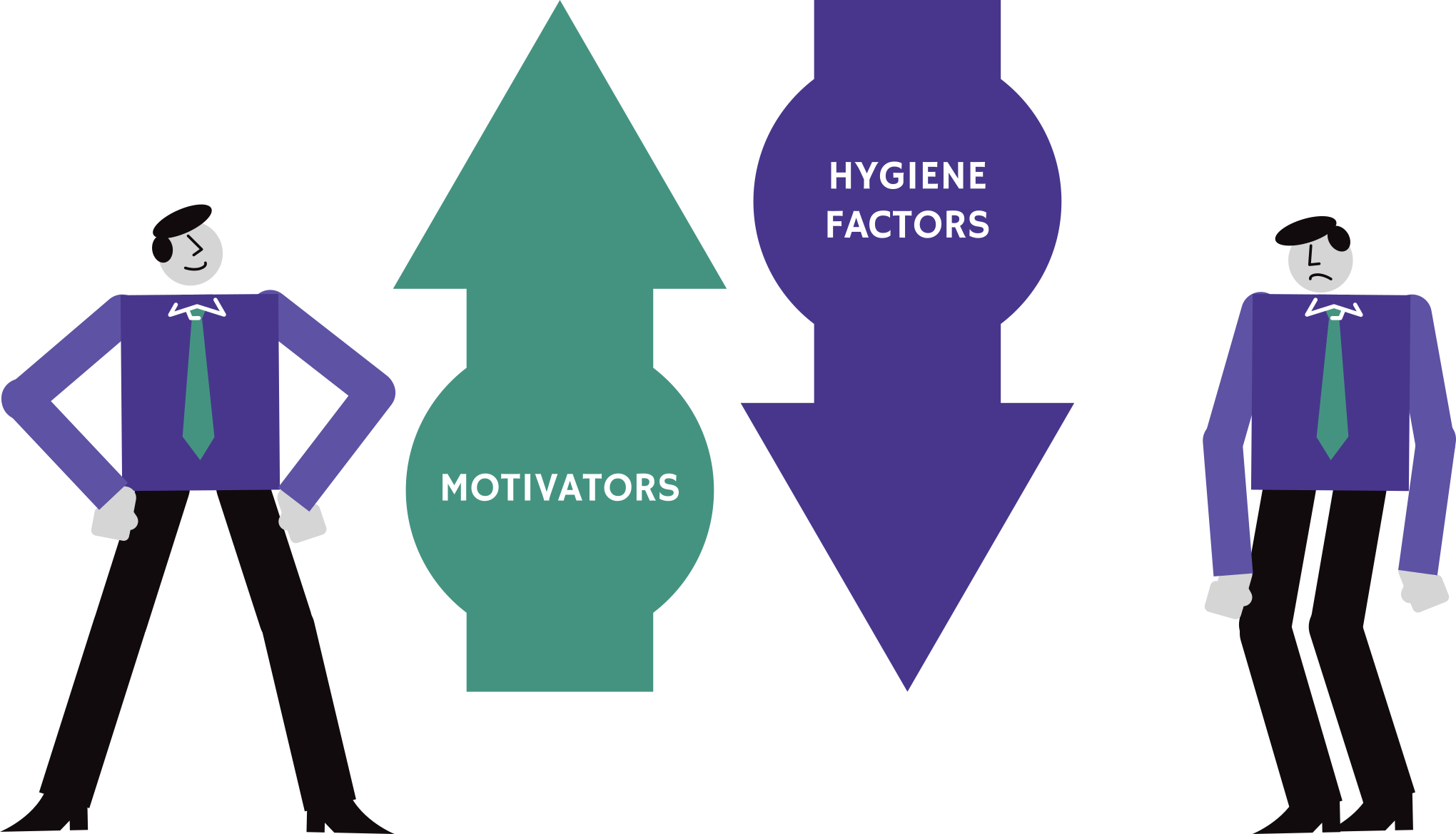
Hygiene factors are things such as company policies, administrative bureaucracy, your manager, your salary, your relationship with your peers, etc. All of these factors are not shown to significantly motivate employees when done well, but they are things that can cause dissatisfaction at work if they do not exist or are done badly.
In contrast, the other factor in Herzberg’s model is “motivators”. These are things such as achievement, recognition, the job, or work itself, responsibility, advancement, and growth. All of these “motivators” were found to be significant drivers of motivation and engagement at work.
So to motivate individuals effectively, Herzberg found that the factors that cause dissatisfaction are fundamentally different from the factors that cause motivation.
Hygiene factors can lead to dissatisfaction and ultimately cause people to leave the organisation or team. On the other hand, motivating factors, such as recognition or interesting and challenging work, can promote growth and motivate employees to go above and beyond. As a manager, it is crucial that you focus on both the hygiene and motivating factors when trying to motivate people effectively.
Model No. 3 – Extrinsic and Intrinsic Motivators
The third model of human motivation is the differentiation between extrinsic and intrinsic motivators, which comes from research from Deci and Ryan in the 1990s and 2000s.
Extrinsic motivators, such as money, job titles, badges, or anything that represents status, are external rewards given by organisations to motivate employees.
Intrinsic motivators, on the other hand, are similar to the needs and values that we talked about, as part of Maslow’s hierarchy. These are things such as autonomy, belonging, curiosity, mastery, and meaning. There are all things that come from within and are motivators that organisations, or you as a manager, can leverage to motivate someone.
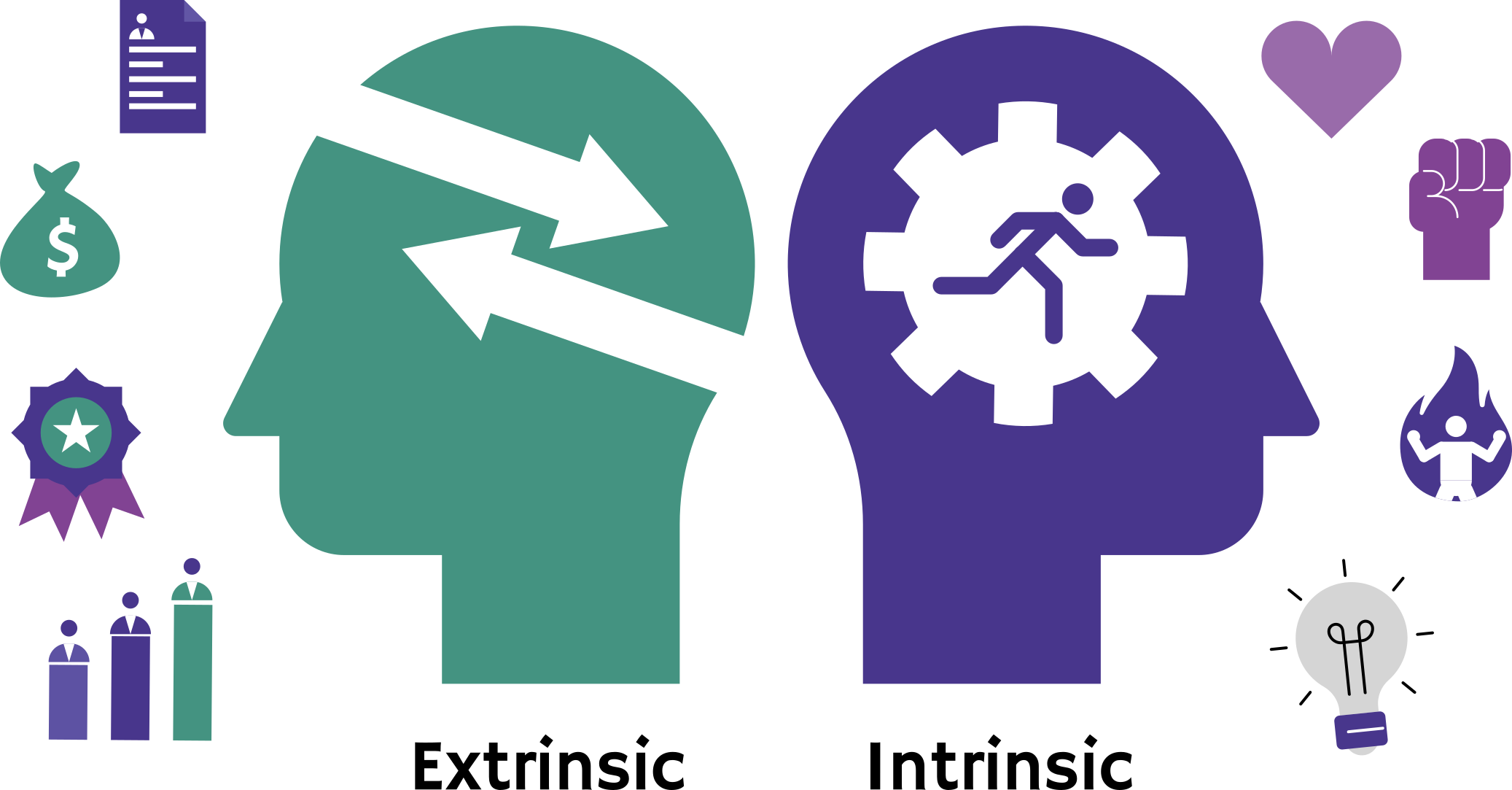
One of the most significant intrinsic motivating factors is creating a sense of meaning and significance in work. One way to create meaning is by connecting individual contributions to the broader purpose of the organisation, reminding employees of the impact of their work on others, and emphasising the significance of tasks that might otherwise seem mundane. Highlighting the impact of an individual’s work on the beneficiary, whether that’s a patient in a hospital, a diner in a restaurant, or the end customer of a technology product, is one of the most effective ways to motivate employees. If you’re looking for high levels of commitment and engagement, then help your employees understand why what they’re doing at work matters.
So, to motivate employees effectively, it is helpful to understand all of these different models of human motivation and tailor their approach to meet the specific needs of your team.
As a manager, you should try to understand what your employees value and care about, while also providing them with meaningful work and goals, offering them opportunities for learning, growth, and development, and recognising and rewarding them for their achievements.
By applying these strategies, you will see a significant increase in engagement and motivation levels, as well as performance and business outcomes.

How To Win Arguments At Work
Have you ever tried convincing someone to try your new idea, only to hit a brick wall?…

5 ChatGPT Tips For Managers (Supercharge Your Management Skills)
You’re sitting at your desk on a Monday morning. You’ve got a team meeting in 10 minutes,…

How To Be Great At Small Talk
Picture the scene. You arrive at a party or a work event, you look around the room,…
