

How To Be Happy At Work And Find A Job You Love
How do you find a job that you love and are truly passionate about?
Achieving happiness at work can not only enhance our productivity but also positively impact our overall wellbeing. However, discovering a job that is both personally and professionally fulfilling can be challenging, especially as we try to balance this with other priorities, such as financial stability.
This blog post will help you to identify what matters most to you on a personal and professional level and how to translate that into finding a job that you truly love.
In order for you to be happy at work and to find a job that you love, there are three steps that you can take:
- Build your self awareness and understand what motivates you
- Understand your strengths (and weaknesses)
- Don’t follow your passion
Step 1: Build your self awareness and understand what motivates you
Learning self awareness and understanding your core values is an important first step in discovering what you want from life and from work. The path to happiness at work varies from person to person, as each individual has unique preferences and priorities.
One way to build your self awareness is to identify your “core values”, by reflecting on what is most important to you and what motivates you. By examining your past experiences and identifying moments when you felt most fulfilled, you can take the first step in finding happiness at work.
To identify your core values, you should ask yourself the following questions to explore the experiences in life that have brought you happiness, pride and fulfilment:
- Happiness: When have you been at your happiest in life and at work? What were you doing and who were you with?
- Pride: When have you felt most proud? Why were you proud and who did you share your experience with?
- Fulfilment: When have you felt the most fulfilled or satisfied? What factors contributed to this feeling?
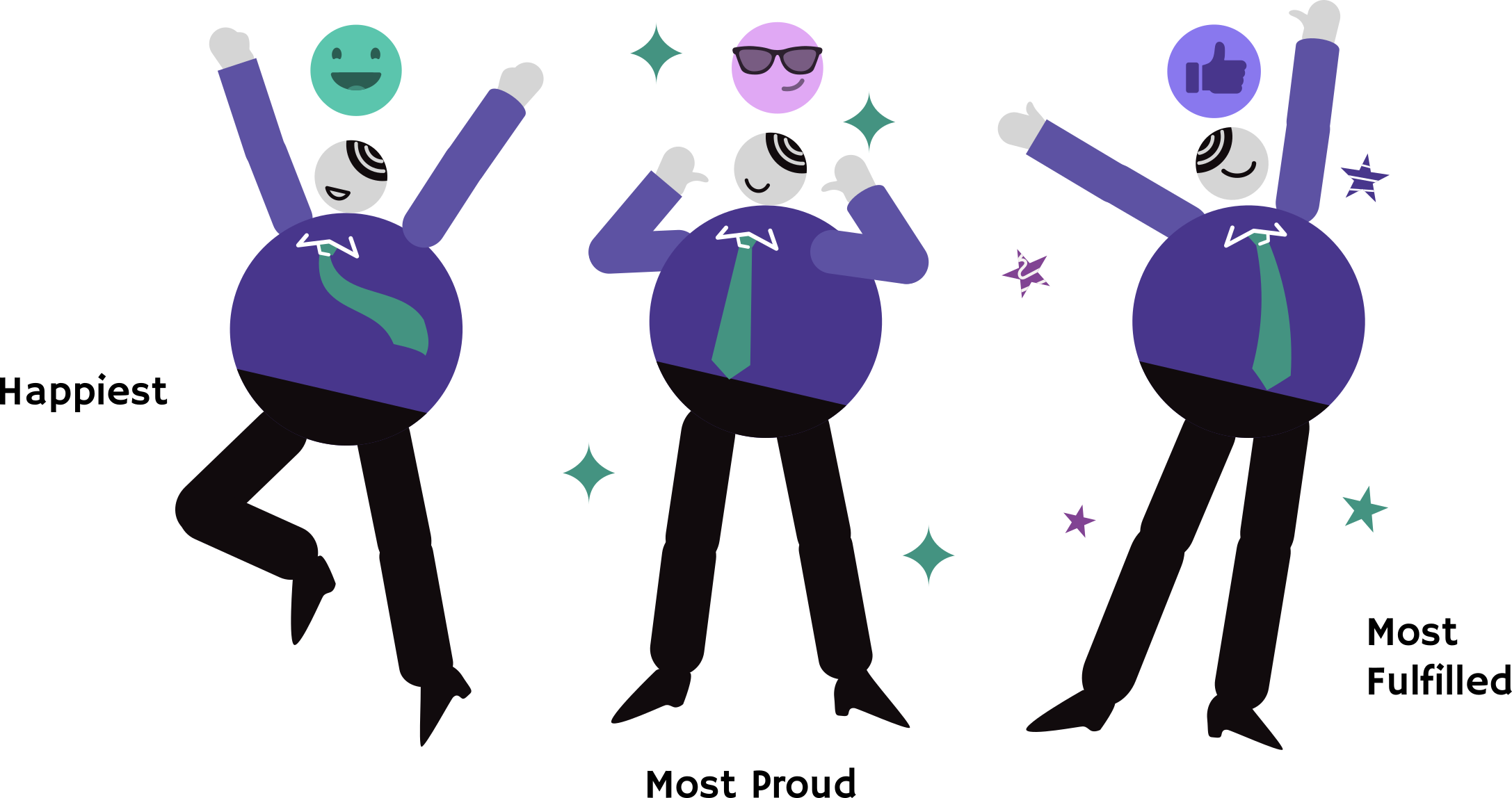
As you consider the answers to these questions you should start to create a list of your own values that help explain why these experiences were so important and memorable to you.
For example, maybe one of your happiest moments is playing football in high school and “relationships” and “teamwork” are core values for you. Or maybe you felt most fulfilled when you were volunteering at a care home, and “community” and “service” should be on your list. It can also be helpful to think about people that you admire and the qualities they possess as you work on defining your own values.
After you have created a list of all of the values that are meaningful to you, you will need to prioritise them and narrow the list down to between 5 and 10 values. You can then use this list as a guide for making decisions and setting goals in your life, by ensuring that any decisions you make are always in line with your core values.
Remember that your personal values may change over time as you gain new experiences and perspectives. It’s important to regularly review and reflect on your values to ensure that they continue to align with your beliefs and priorities.
Step 2: Understand your strengths and weaknesses
Knowing your strengths and weaknesses can allow you to capitalise on the areas that come naturally to you and to mitigate the areas that don’t.
Most people are good at the things that they enjoy, and they enjoy the things that they’re good at.
However, the key when thinking about your strengths is to identify what you’re good at compared to most other people in your company, or even in the world, not necessarily what you’re best at in comparison to your other skills and abilities.

When trying to understand your strengths you should think about the skills that you excel at or enjoy doing the most. You can seek help in understanding this by asking others around you or by taking one of the many assessments that are available online (such as StrengthsFinder from Gallup or Core Drivers from Deeper Signals) to help you to better understand your strengths and weaknesses.
Once you’ve identified your strengths, you should try to build on these areas and find a way that you can incorporate them into your work as often as possible. That said, while it is true that maximising your strengths is a great approach to enjoying work, it is also important not to completely ignore your weaknesses. You should attempt to manage your weaknesses as much as possible, so they do not hold you back in the future.
Step 3: Don’t follow your passion
There are a lot of “experts” who will tell you that if you want to find a job that you love, you should just follow your passion, and the rest will fall into place.
However, our advice is not to follow your passion, but to follow the goal of ending up passionate about your work. While the idea of following your passion might intuitively make a lot of sense, a better approach is to try and find work that you believe in. You should aim to make passion the output and not the input.

If we spend our time working on things we don’t care about, then this is a recipe for stress, for burnout and ultimately unhappiness. But if we work on something we deeply care about, then we will experience passion. If you can find something to work on that you believe in, and that you find meaningful, then you will become passionate about that work.
So how can you take a job that you like or are good at, and turn it into a job that you love and are passionate about?
In order to craft a job that you love, it is important to have ownership and autonomy in your role, variety in the work that you do and an ability to learn new things. In addition, by understanding your values and your strengths (as explained in steps 1 and 2), you can then look to modify your job tasks and responsibilities to better align with your skills, strengths, interests, and values.
So to do this, you need to not only better understand what you’re looking for from work, but also to ensure that you have an environment (and a manager) that supports you in allowing you to have autonomy, to adapt your job and to play to your strengths.
This means that great jobs need to be made, not found.
By understanding your values and your strengths, you can find a job that you like and that you’re good at. You can make this job great by ensuring that you’re working for a manager that allows you to have ownership over your work and who supports you to grow and to learn. Finally, and most importantly, you also need to ensure that what you are working on is meaningful to you.
Ultimately, finding happiness at work is not about what you do, it’s about who you are while you’re doing it.

How To Win Arguments At Work
Have you ever tried convincing someone to try your new idea, only to hit a brick wall?…

5 ChatGPT Tips For Managers (Supercharge Your Management Skills)
You’re sitting at your desk on a Monday morning. You’ve got a team meeting in 10 minutes,…

How To Be Great At Small Talk
Picture the scene. You arrive at a party or a work event, you look around the room,…
